

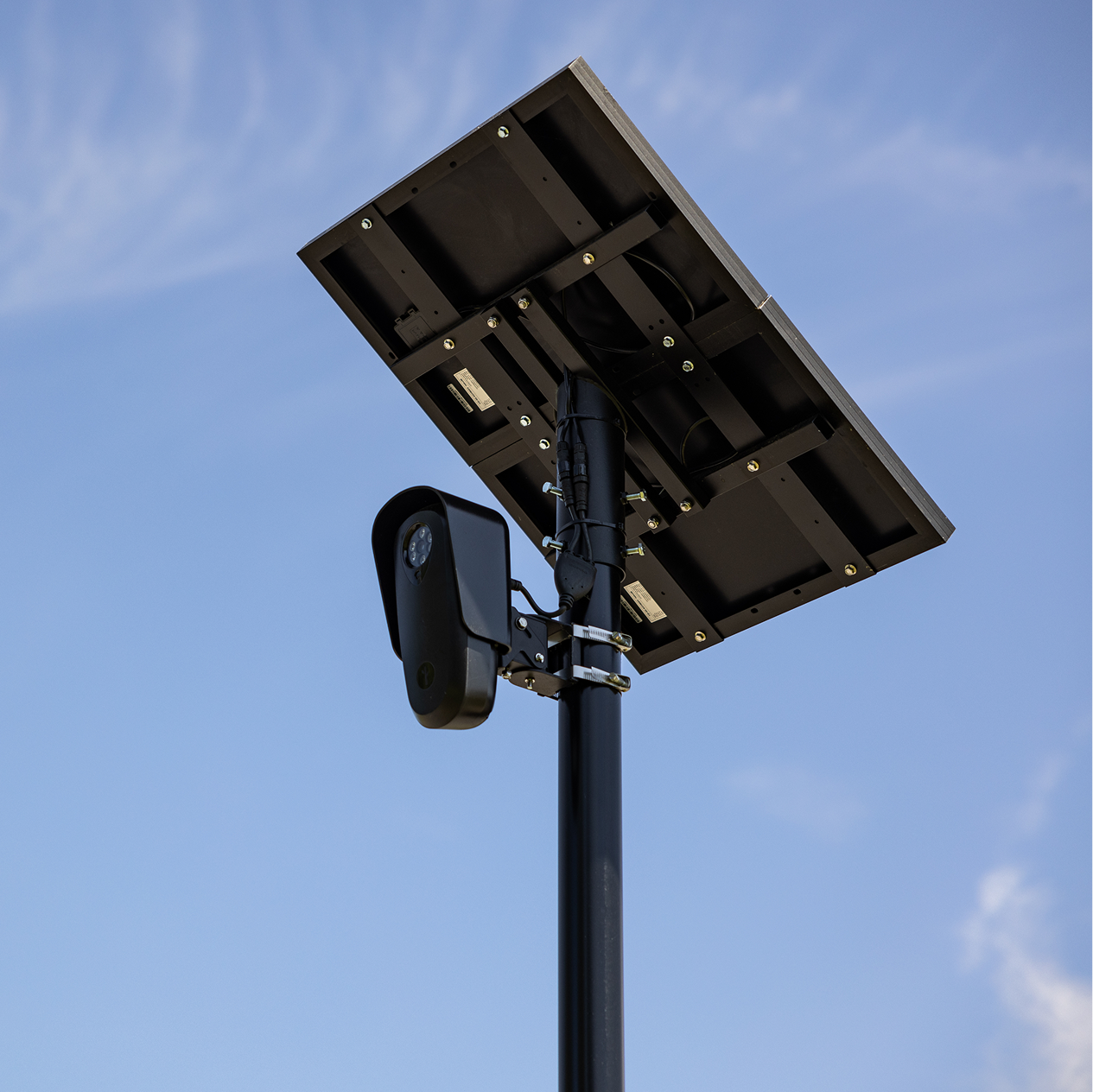
Understanding what the cameras do, what the Constitution says, and why communities are debating them
Automated license-plate-reading cameras, including systems made by Flock Safety, are becoming increasingly common across the United States.
These cameras are designed to photograph passing vehicles and turn information such as a license plate, vehicle type, color, date, time, and location into searchable records.
Supporters say the systems help police find stolen vehicles, locate suspects, respond to AMBER Alerts, and investigate serious crimes.
Critics say the same technology can create a powerful surveillance network capable of recording the movements of thousands of people who are not suspected of committing any crime.
So where is the line between public safety and personal privacy?
What Is a Flock Camera?
A Flock camera is a type of Automated License Plate Reader, commonly called an ALPR.
Unlike an ordinary security camera that simply records video, an ALPR can identify vehicle information and place it into a searchable database.
A police investigator could potentially search for a particular plate or vehicle description and determine whether cameras recorded that vehicle.
The important distinction is that the system is not simply watching traffic.
It is creating searchable records.
The Argument for the Cameras
The strongest argument for Flock cameras is simple: police officers cannot be everywhere at once.
Suppose a vehicle is stolen during the night.
If the license plate is entered into a law-enforcement database, a Flock camera detecting that vehicle could alert officers and provide its recent location.
The same technology could potentially assist investigators looking for a vehicle connected to:
- A missing child
- A violent crime
- A stolen vehicle
- A wanted suspect
- A robbery
- A hit-and-run investigation
Supporters also point out that cameras can provide evidence that is more accurate than someone’s memory.
Instead of a witness simply remembering “a dark-colored SUV,” investigators might have an image, vehicle description, time, and location.
That information could help identify a suspect.
It could also help eliminate an innocent person from suspicion.
The Privacy Concern
Privacy advocates generally are not arguing that police should be prohibited from seeing a license plate on a public road.
License plates are intentionally visible.
The concern is the scale of the technology.
Consider the difference.
A deputy standing beside U.S. 19 might see hundreds of vehicles during a shift.
Now imagine cameras automatically recording vehicles 24 hours a day at locations throughout the county.
Then imagine similar cameras throughout Florida.
If those systems can share information, the question becomes much larger than whether police can see your license plate.
The question becomes:
Can the government reconstruct where you have traveled?
What Does the Fourth Amendment Say?
The Fourth Amendment to the United States Constitution protects Americans against unreasonable searches and seizures.
Traditionally, courts have held that people have a limited expectation of privacy concerning things they knowingly expose in public.
That includes a vehicle’s license plate.
That legal principle favors law enforcement.
However, modern technology has created a question the writers of the Constitution could never have anticipated:
Can collecting thousands of individually public observations eventually become government surveillance protected by the Fourth Amendment?
The U.S. Supreme Court has already dealt with similar questions involving GPS tracking and historical cellphone-location information.
Those cases show that the amount and duration of location information collected can matter.
That does not automatically make Flock cameras unconstitutional.
It does mean the constitutional issue may change as networks become larger and more capable.
What Have Courts Said About Flock?
A significant case involving Flock cameras occurred in Norfolk, Virginia.
Norfolk operated more than 170 Flock cameras on public roads.
A defendant challenged police use of information from that network as a violation of the Fourth Amendment.
In 2026, the Virginia Court of Appeals rejected that argument under the circumstances involved in the case.
That decision is important.
But it does not mean every possible use of Flock cameras everywhere in the United States has been declared constitutional.
A system containing more cameras, longer retention periods, or broader data sharing could eventually present different constitutional questions.
What Does Florida Law Say?
Florida law specifically recognizes Automated License Plate Recognition systems.
The state regulates the use and retention of ALPR information.
Florida law also generally treats identifying license-plate-reader information held by government agencies as confidential rather than an ordinary public record.
The information can be shared between criminal-justice agencies for official purposes.
Florida law therefore does not prohibit this technology.
But allowing the technology does not eliminate questions about how individual agencies use it.
A Simple Privacy Example
Imagine a fictional Citrus County resident named John.
John hasn’t committed a crime.
On Monday he drives to work.
Tuesday he visits a doctor’s office.
Wednesday he goes to church.
Thursday he visits a friend’s house.
Friday he attends a political meeting.
Saturday he visits a gun store.
Each individual trip takes place in public.
But if enough cameras record those trips and the records can be searched together, the combined information tells considerably more about John’s private life than any individual observation does.
That is at the center of the privacy debate.
The issue isn’t necessarily whether a license plate is private.
The issue is whether collecting enough public information can create a detailed picture of someone’s private life.
Can the System Be Misused?
Any database containing sensitive information can potentially be misused.
There have been reports in other jurisdictions involving officers accused of conducting unauthorized or personal searches of ALPR databases.
Supporters of Flock point out that searches can be logged and audited.
That can allow departments to discover improper searches and discipline employees.
Critics counter that audit logs only help if agencies regularly review them and enforce meaningful penalties for misuse.
Both arguments are important.
What Flock Cameras Do Not Automatically Do
A license-plate reader should not automatically be confused with facial-recognition technology.
Flock’s license-plate system primarily identifies vehicles.
A camera observation also does not establish who was driving the vehicle.
A license plate identifies a vehicle—not necessarily the person sitting behind the wheel.
For that reason, an ALPR alert should generally be considered an investigative lead rather than absolute proof that a particular person was at a particular location.
What About Mistakes?
Automated systems are not perfect.
A camera could potentially misread a license plate, and information returned by a computer can also be misunderstood by investigators.
This makes human verification important.
If a system indicates that a stolen vehicle passed a camera, officers should still verify that the license plate, vehicle description, and other information match before assuming the system is correct.
What About Citrus County?
This is where local transparency becomes important.
Citrus County residents should know how automated license-plate readers are being used locally.
CCI has not yet independently verified an authoritative Citrus County Sheriff’s Office or county document containing a complete list of every existing Flock camera and every proposed location.
For that reason, we are not publishing an unverified location map as fact.
[INSERT CITRUS COUNTY EXISTING/PROPOSED CAMERA MAP HERE WHEN VERIFIED]
Residents should be able to get clear answers to several basic questions:
- How many Flock or ALPR cameras currently operate in Citrus County?
- How many additional cameras are proposed?
- Where are the government-operated cameras located?
- Who owns and controls each camera?
- How long are vehicle records retained?
- Can the Citrus County Sheriff’s Office search records from other counties or states?
- Can outside agencies search Citrus County records?
- What justification is required before an employee searches for a vehicle?
- Are searches regularly audited?
- What happens if an employee improperly uses the system?
These are not anti-police questions.
They are oversight questions that citizens can reasonably ask whenever government uses powerful technology.
Potential Benefits
Flock technology may help law enforcement:
- Recover stolen vehicles
- Locate vehicles connected with serious crimes
- Respond to AMBER Alerts
- Identify investigative leads
- Review vehicle information faster than manually searching surveillance video
- Extend the reach of a limited number of deputies
Those are meaningful public-safety benefits.
Potential Concerns
The technology also raises legitimate questions involving:
- Collection of information about innocent motorists
- Historical tracking of vehicle movements
- Sharing information between agencies
- Length of data retention
- Unauthorized searches
- Cybersecurity
- Accuracy
- Government oversight
- Whether warrants should eventually be required for extensive historical searches
Those are meaningful privacy concerns.
So, Are Flock Cameras Constitutional?
There is currently no simple legal basis for saying that Flock cameras themselves are unconstitutional.
Courts have allowed automated license-plate-reader evidence in cases challenging the technology under the Fourth Amendment, and Florida law specifically recognizes and regulates ALPR systems.
But the constitutional debate is not necessarily finished.
One camera recording a vehicle traveling down a public highway presents one constitutional question.
Hundreds or thousands of interconnected cameras capable of documenting someone’s movements for an extended period may eventually present a very different question.
Courts—including potentially the United States Supreme Court—may ultimately have to determine where ordinary observation of public roads ends and constitutionally significant mass location surveillance begins.
Finding the Balance
Flock cameras do not have to be viewed as either a miracle crime-fighting tool or an Orwellian surveillance system.
They are technology.
Like many technologies, their value and their danger depend heavily on how they are used.
Residents can support giving law enforcement effective tools while also supporting strong safeguards on government surveillance.
The most important questions may therefore not simply be:
Do the cameras help solve crimes?
or
Are the cameras legal?
Residents should also ask:
What information is being collected about us?
Who can search it?
How long can it be kept?
Who can it be shared with?
What prevents misuse?
And perhaps most importantly:
Who is watching the people doing the watching?
Editor’s Note
This article is intended to explain both the public-safety benefits and the constitutional and privacy concerns associated with automated license-plate-reader technology. It does not allege improper conduct by the Citrus County Sheriff’s Office or conclude that the agency’s use of ALPR technology is unconstitutional.
Photo Note
Photographs of Flock cameras used in this article are representative examples unless specifically identified and independently verified as Citrus County installations.